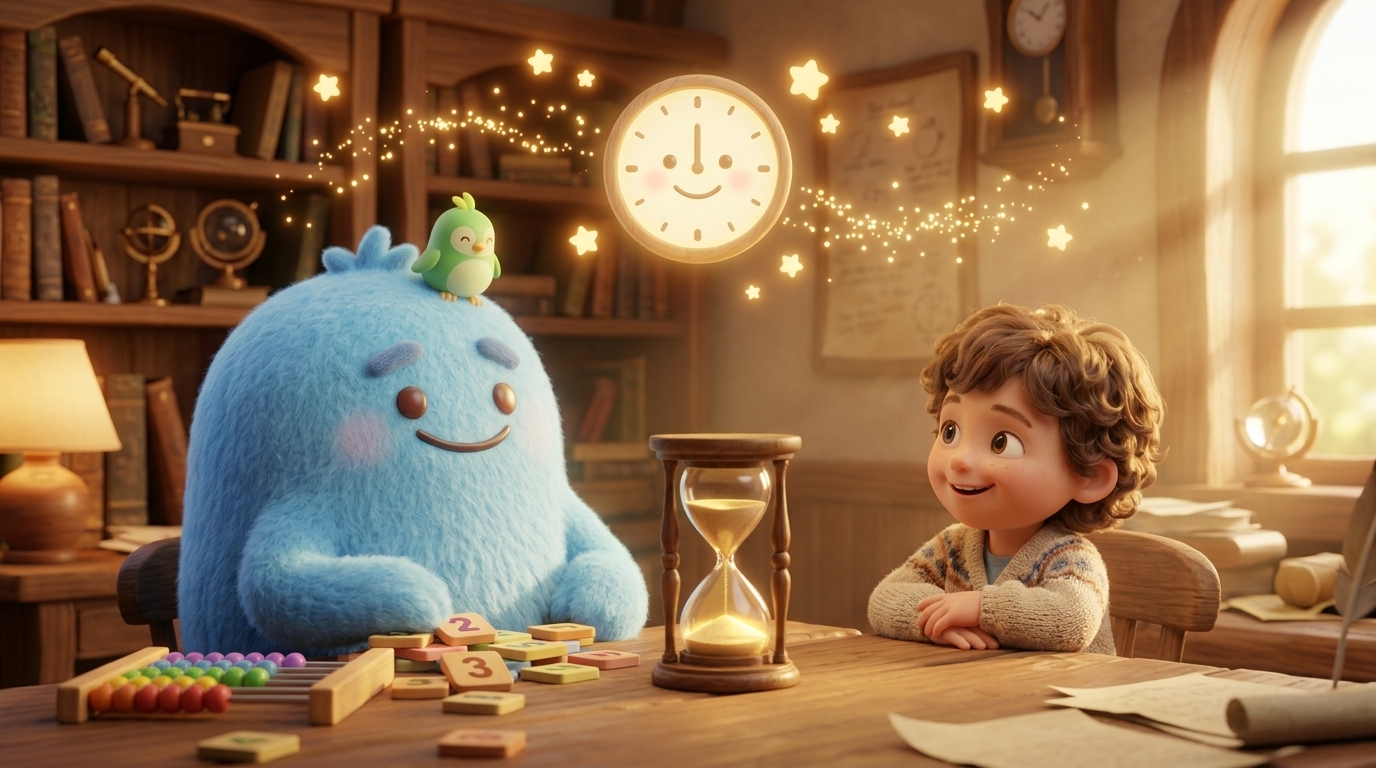
To practise maths with your child without turning it into a daily struggle, choose one small goal and a short activity. Watch whether your child still wants and is able to participate. There is no single ideal duration for everyone, and the plan should allow you to finish or change course.
“Stress-free maths” can describe a parent's intention, not a promise that difficult tasks never bring emotions. You can agree on help, breaks and endings without setting a required number of minutes or guaranteed results.
Maths practice at home: choose a small goal
Replace “Let's do maths” with something visible: compare two groups, show 5 + 2 with blocks or align ones in a written calculation. One goal makes it clearer what you are practising.
Avoid combining unnecessary demands. You can write while your child explains subtraction; when practising digit shapes, use familiar numbers. Say in advance: “We'll show this example, then decide whether we want another.”
How to practise maths in short sessions
Try a familiar beginning, one task and an ending. Count blocks for a building, introduce a small change such as adding two, then ask how you checked the answer.
The response can be spoken, drawn or demonstrated. No extra test is needed before putting materials away. Short does not mean rushed: continue an interested discussion or stop early when participation becomes difficult.
Regular opportunities, not a compulsory streak
Choose a moment that often suits your day, perhaps after rest or while preparing a snack. Keep it as an invitation rather than an obligation regardless of circumstances.
If a day is missed, do not double the next session. If the chosen time repeatedly leads to tiredness or resistance, change the arrangement. Returning to questions such as “How many?” can happen outside a formal lesson.
Different activities around one topic
For making ten, use a frame with blocks, a drawing of dots and later a similar app task. Check whether the same relationship is recognizable in each representation.
Do not change materials solely for novelty. Staying with a familiar model is an option. Our worksheets and learning apps comparison discusses what each format can offer; today's goal should guide the choice.
Alternate screen activities with objects
Show a small example on the table before opening a game. After one task, invite your child to demonstrate something similar with blocks. This is an occasional connection, not a condition attached to every screen.
Number Land includes counting, quantity comparison and arithmetic tasks. Choose a relevant type and leave room for conversation, movement and ordinary play. Agree on an ending, such as after the current task, instead of requiring a whole world to be completed. See our shared screen-time guide.
Observe rather than automatically adding more
Notice requests to stop, materials being put aside or repeated pauses. Offer a hint, a different example or an ending without deciding that you know the precise reason.
Use smaller numbers or objects if the task is unclear. A correct answer does not automatically require a harder task; repeating a familiar activity can be a choice. For specific language around mistakes, see responding to maths errors.
An adaptable sequence of activities
One occasion: match cups to people. Another: compare two groups of blocks. Later: draw similar groups or choose a related game. Return to a favourite activity afterward if desired.
This is not a day-by-day timetable with sessions to make up. A spontaneous question can replace a scheduled activity. If useful, note one observation, such as “Moving counted blocks helped,” to inform the next choice rather than rank performance.
What can you try today?
Prepare one small situation and invite your child to solve it with you. Explain that help and stopping are available. Offer two suitable formats, perhaps blocks or a drawing.
Afterward, identify one thing to keep: a clearer instruction, a better time or fewer objects. There is no need to judge whether the session used time perfectly.
Parents’ questions
How many minutes a day?
No single duration suits every child and task. Observe participation and allow an earlier ending.
Should a missed day be made up?
Home play need not double the next day. Return at a suitable opportunity, while considering school arrangements separately.
What if my child only chooses the app?
Offer one related example with objects or a real household job. It does not need to become a long lesson or a reward for accepting paper.
A final thought
Brief, recurring activities can be a practical arrangement for home maths. Let the plan support shared work, with room for help, changes and an ordinary ending.