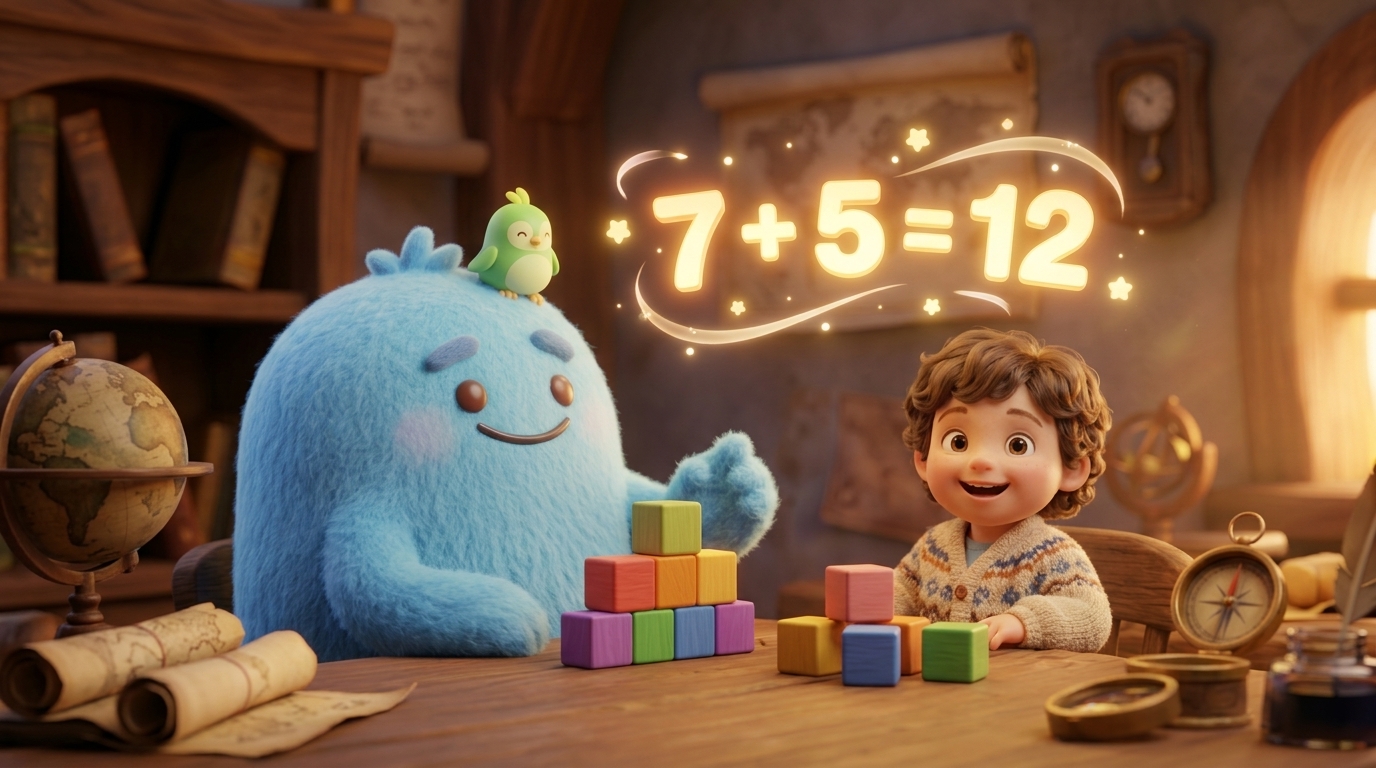
To teach addition, begin by joining two small groups of objects. Move two blocks and three blocks together, count the total, then connect the action with a picture and 2 + 3 = 5. Each number now refers to something your child has just done.
This guide focuses on understanding addition, from joining groups to 7 + 5. For a child who already understands plus, our mental addition and subtraction guide explores calculation strategies. You do not need to cover every example in one sitting.
Addition for children: start with a story
Two cars are parked; three more arrive. Let your child move the cars and identify the original and arriving groups. Count them all, then ask what changed. Counting from one is a valid starting method; speed is not the aim.
You can also join two groups already present, such as red and blue blocks. Both joining and adding more can be represented by addition, although the stories differ.
Objects, pictures and symbols: CPA
Concrete – Pictorial – Abstract means moving from real objects through pictures to mathematical notation. Arrange the blocks, draw circles, then write the equation. You can return to objects whenever the symbols are unclear.
Our CPA guide explains this connection. EEF discusses using objects and representations to show mathematical relationships, without promising an outcome from one activity.
Read the equals sign as “has the same value as.” Two and three blocks on one side can be matched with five on the other. It is more than an instruction to supply an answer.
Example 2 + 3: count the whole group
Place two blocks on one sheet and three on another. Bring the sheets together, count five, then draw two circles and three circles. Write 2 + 3 = 5 underneath. Invite your child to invent a similar story while you arrange the objects.
Example 5 + 4: count on from a known quantity
Show five blocks and four additional ones. Start with the five you already know, moving the others one at a time while saying six, seven, eight, nine.
The first added block is six, not five. If this is confusing, recount everything and compare the methods. Your child does not need to abandon counting all the objects immediately.
Example 7 + 5: make ten
Draw ten spaces in two rows of five. Fill seven spaces and leave five blocks beside the frame. Three spaces are empty: move three of the extra blocks into them.
Now the frame holds ten and two remain outside. Write 7 + 5 = 7 + 3 + 2 = 10 + 2 = 12. Five was split into three and two; no objects disappeared. If the notation is too much, keep the blocks and explore splitting five first.
Show addition on a number line
Draw equally spaced numbers from zero to twelve, increasing to the right. For 2 + 3, start at two and make three jumps: to three, four and five. Count jumps, not the starting point.
For 7 + 5, try five small jumps or a jump of three to ten followed by two. Connect this with the blocks. Explain the number line itself before using it for unfamiliar calculations.
When the signs or counting get mixed up
Ask: “Are we adding objects or taking them away?” Recreate the story before choosing the sign. Move counted objects aside if some are missed. Use fewer objects if keeping track is difficult.
Avoid correcting handwriting, pencil grip and arithmetic at once. You can write the answer while your child explains the addition.
What can you try today?
Choose one short story, act it out and draw it. Add notation if useful. Ask how you checked the total. Number Land includes addition models and ten-frame activities as an extra way to practise alongside objects and conversation. For broader foundations, see number sense.
Parents’ questions
At what age should children add?
This guide sets no age standard. Match the example to what your child can show with objects and to the work discussed with their teacher.
Is finger counting allowed?
Fingers can represent small quantities. Offer blocks or pictures too, without removing a useful support.
Must children calculate mentally immediately?
No. Explore what the operation means first, then offer calculation without objects when that step makes sense.
A final thought
Connect the action, picture and notation. Let your child check and revisit examples. Understanding what plus represents matters more here than completing a long page of answers.