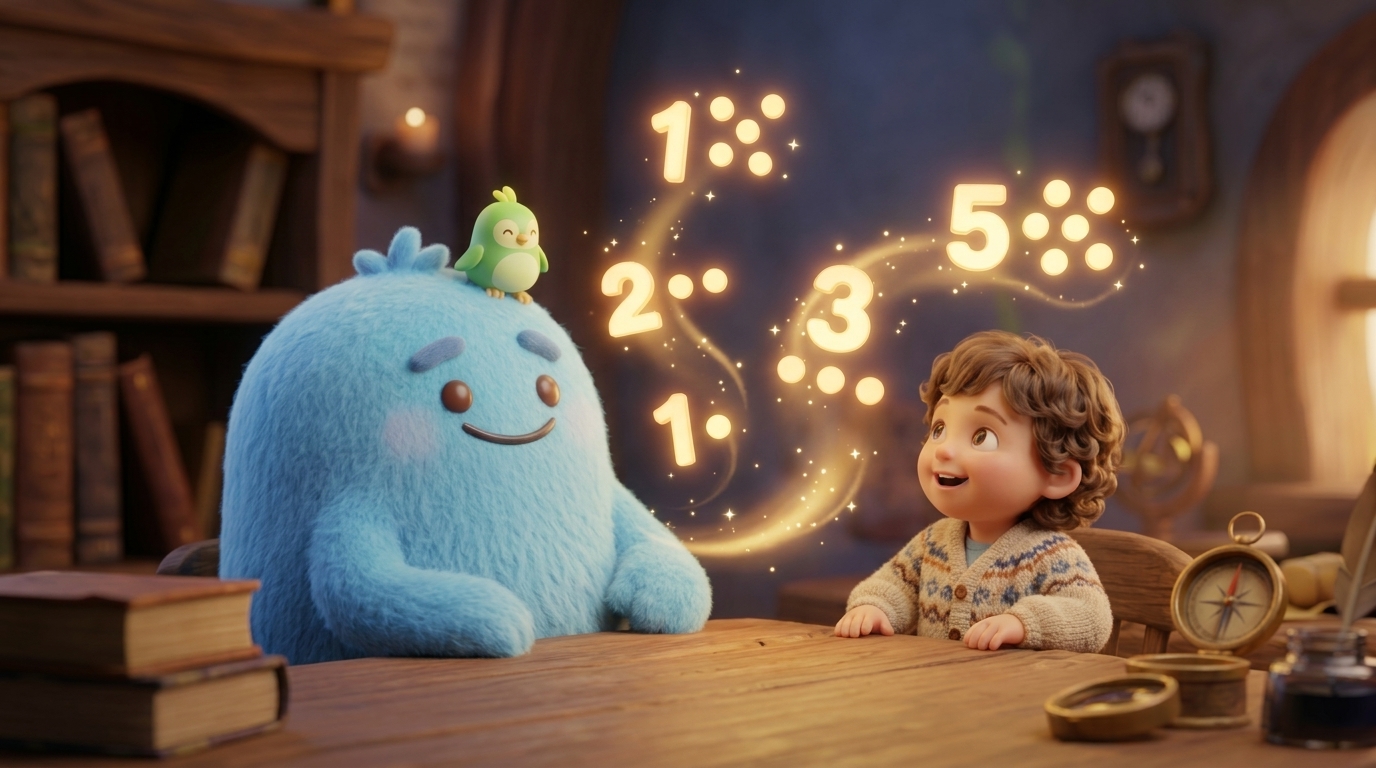
Number sense means understanding what numbers represent and how quantities relate to each other. A child uses it when noticing that someone needs another cup, one plate has more apple pieces, or five blocks can be split into three and two. Learning to count involves more than reciting number words.
You do not need special equipment. Choose objects that can be moved, matched and separated. The activities below are invitations to explore, not a test or a list of milestones to achieve by a particular age.
Number sense: connecting words with quantities
“Four” can describe four chairs, four steps or four blocks. Saying number words, counting objects and answering “How many altogether?” are related but different actions. Observe each in play rather than assuming that a long counting sequence tells the whole story.
NCETM’s explanation of cardinality describes how the final number word in a count represents the total quantity. After counting four blocks, say: “Four. There are four blocks here.”
Count objects that can move
Put four blocks on the table. Invite your child to move each one onto a sheet of paper while saying one number word per move. Moving counted objects away from the rest gives you a visible way to check that each was counted once.
Then spread the same blocks out. Ask how many there are now, without adding or removing any. If your child wants to count again, let them. You can check together that the arrangement changed but the quantity did not.
If a block is counted twice, say: “We already moved this one. Which ones are still waiting?” This gives a concrete next step instead of a general instruction to concentrate.
More, fewer and the same: match pairs
Set out five spoons and four cups. Place one spoon beside each cup. One spoon has no partner: there are more spoons than cups. Add another cup and check that every item now has a partner. There are the same number of each.
Spread the cups out again. A longer row does not necessarily contain more objects. With large and small blocks, clarify your question: “Which group has more pieces?” rather than asking about size and quantity at once.
Recognizing small quantities
Briefly show two or three blocks, then leave them visible so your child can check their answer. Ask whether they saw three together or two and one. There is no need for a speed challenge.
Quick recognition of small quantities without counting each object is called subitizing. Our guide to subitizing explores this further. It is one part of working with quantities, alongside counting, comparing and splitting groups.
Estimation means making a reasonable guess
Put a few blocks in a clear container. Ask whether another two or a whole pile might fit, then check. For quantities, compare three visible toy cars with another small group: “Fewer, about the same, or many more?”
Discuss the guess instead of marking it wrong. Match the cars or arrange them in rows to see what the original observation missed. Estimation and exact counting serve different purposes.
One number, different parts
Split five blocks between two plates: four and one, then three and two. Bring them together each time. If helpful, cover one plate: “We can see two. How many are hidden?” Leave everything visible if hiding a group makes the task confusing.
These examples connect naturally with first addition activities, but not every game needs a written equation.
What can you try today?
Choose one real job: setting the table, sharing fruit or sorting blocks. Ask one question, wait, and let your child check the answer. Finish when the shared job is done.
Notice a specific action, such as matching cups or recounting after a rearrangement. That is more useful for choosing the next activity than a broad label such as “good at maths.”
Parents’ questions
Does counting to a hundred show strong number sense?
It does not tell you everything about understanding small quantities. Explore giving four objects, comparing groups and splitting five into parts separately.
Should I introduce written digits immediately?
You can place a digit card beside a counted group. Keep connecting the symbol with the quantity rather than replacing all object play with digit recognition.
Can an app replace these activities?
Number Land includes quantity comparison and small-set recognition tasks. Treat them as another way to practise, alongside real objects and conversation.
A final thought
Questions such as “How many?”, “Which has more?” and “How else could we split this?” offer simple starting points. For more everyday contexts, explore maths in an ordinary day.