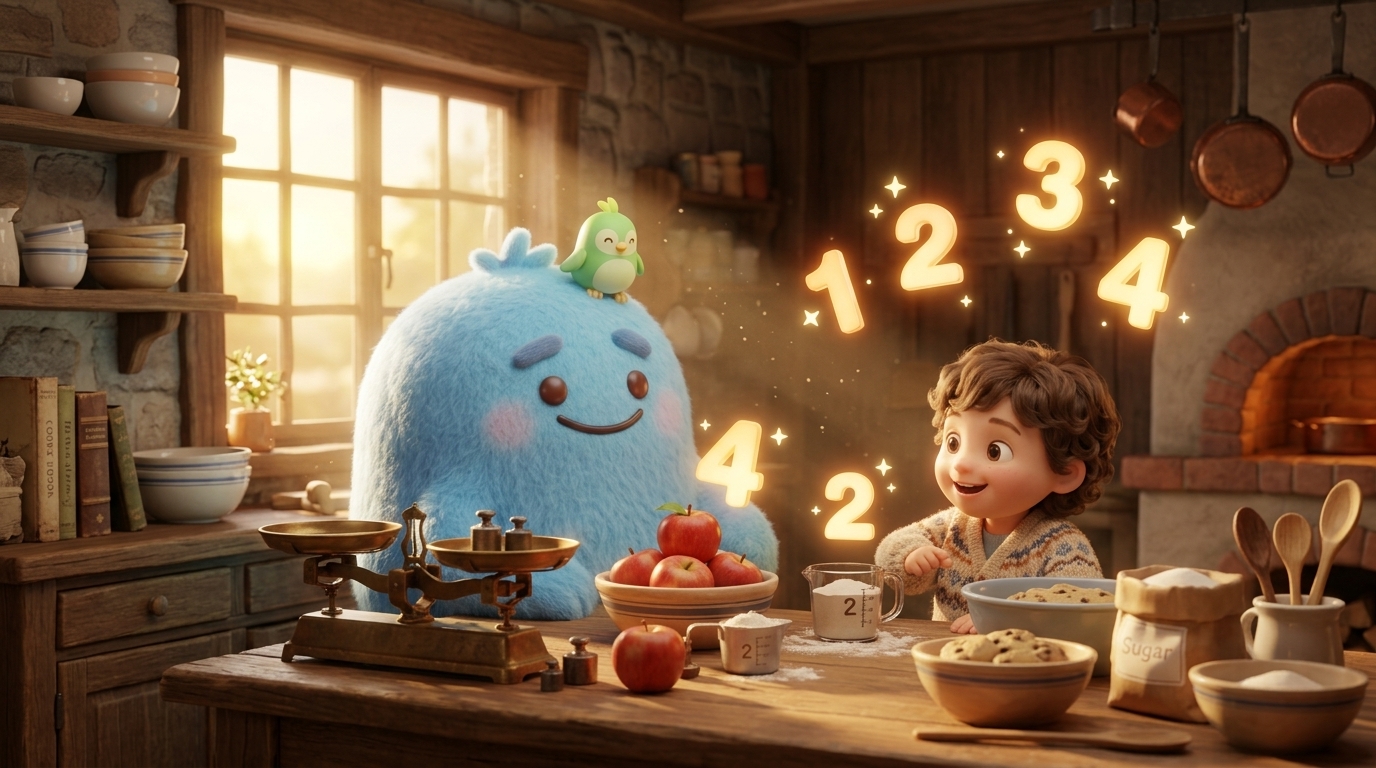
Maths at home can be part of an ordinary day: deciding how many cups to bring, sharing fruit or comparing lengths. Choose one real situation and let your child help solve it. You do not need another worksheet.
These twelve opportunities are not a daily checklist. Counting serves a practical purpose, and the conversation can finish when the job is done.
Maths at home: twelve everyday opportunities
1. Shopping for a known number
Plan one apple for each of four people. Draw four spaces on a shopping list and mark the apples as they are added. With three already chosen, ask how many more are needed. Check the shopping against the list afterward.
2. Fruit: a whole collection and its parts
Share six pieces between two plates, equally or as two and four. Name the unit: whole apples or pieces. Cutting two apples creates more pieces, not more whole apples.
3. Setting the table
Give each person one cup, matching cups to places. If a guest joins, work out what to add. There is a real reason to compare quantities. Explore this further in our number sense guide.
4. Stairs: steps and the starting point
On a suitable staircase, count each step taken rather than counting the landing as step one. You can also name first, second and third. Keep walking normally; if moving safely needs full attention, draw the route later instead.
5. Cooking with equal measures
For three scoops of oats, move one block aside after each scoop. It records what has already been added. Use the same scoop: a tablespoon and a teaspoon are different units, even before you introduce millilitres.
6. Portions on plates
Prepare two bread pieces for each of three plates. How many pieces altogether? Reverse the situation by sharing six pieces between three plates. Our division guide explores this distinction.
7. Time and sequence
Talk about what happens before lunch and afterward. Use a clock as a reference, such as one whole hour followed by the next. Do not add minute-reading while the clock face itself is unfamiliar. Draw the two hand positions if helpful.
8. Coins: pieces versus value
Compare one two-unit coin with two one-unit coins in a currency you use, or draw pretend coins. The number of coins differs, but their total value can match. Leave complicated change and smaller units for later.
9. Laundry: pairs and sorting rules
Match socks, naming whether you count pairs or individual socks. Three pairs contain six socks. Sort by owner, colour or clothing type, letting your child suggest a rule. Not every mathematical activity needs an equation.
10. Blocks: what does the building need?
Compare two pillars supporting a toy garage roof. If one is shorter, match identical blocks to see what is missing. Or prepare three blocks for each of four windows. Ask where a quantity genuinely helps the construction rather than interrupting every choice.
11. Cars: agree on what counts
Count cars of one colour in a defined parking row. Agree on the boundary before starting. Use a tally mark for each car, then compare colour groups. Choose a place where observing traffic does not distract from moving safely.
12. Lengths: align the starting edges
Compare two ribbons with their ends against the same table edge. Then measure using identical blocks placed without gaps. “Eight blocks long” depends on the block size; changing the unit changes the numerical measurement.
Keep the task connected to its purpose
A cup count helps everyone get a drink; a measurement helps choose ribbon. Let your child check the answer by completing the job. If the question becomes confusing, simplify the language or quantity rather than turning it into a test.
You do not need to use every opportunity. A child building freely or helping with a meal may prefer to continue without extra questions.
What can you try today?
Choose a job already on your schedule. Ask for genuine help with cups, portions or pairs. Ask one question, wait and let the answer be shown. There is no need to add a written exercise afterward.
For a separate play session, explore maths games for preschoolers. Number Land can provide another format for counting and comparing, but everyday activities do not need to move onto a screen.
Parents’ questions
Must I use formal mathematical terms?
Clear language is enough: more pieces, longer ribbon, the same number each. Add a formal term when it helps describe the action.
What if my child does not want to count?
Keep the activity as an ordinary shared job. Not every opportunity has to become educational conversation.
Does this replace schoolwork?
It serves a different purpose and can complement learning. Discuss specific practice needs with the teacher.
A final thought
Maths through play can fit a real day. Choose useful moments without turning family life into a continuous assessment.