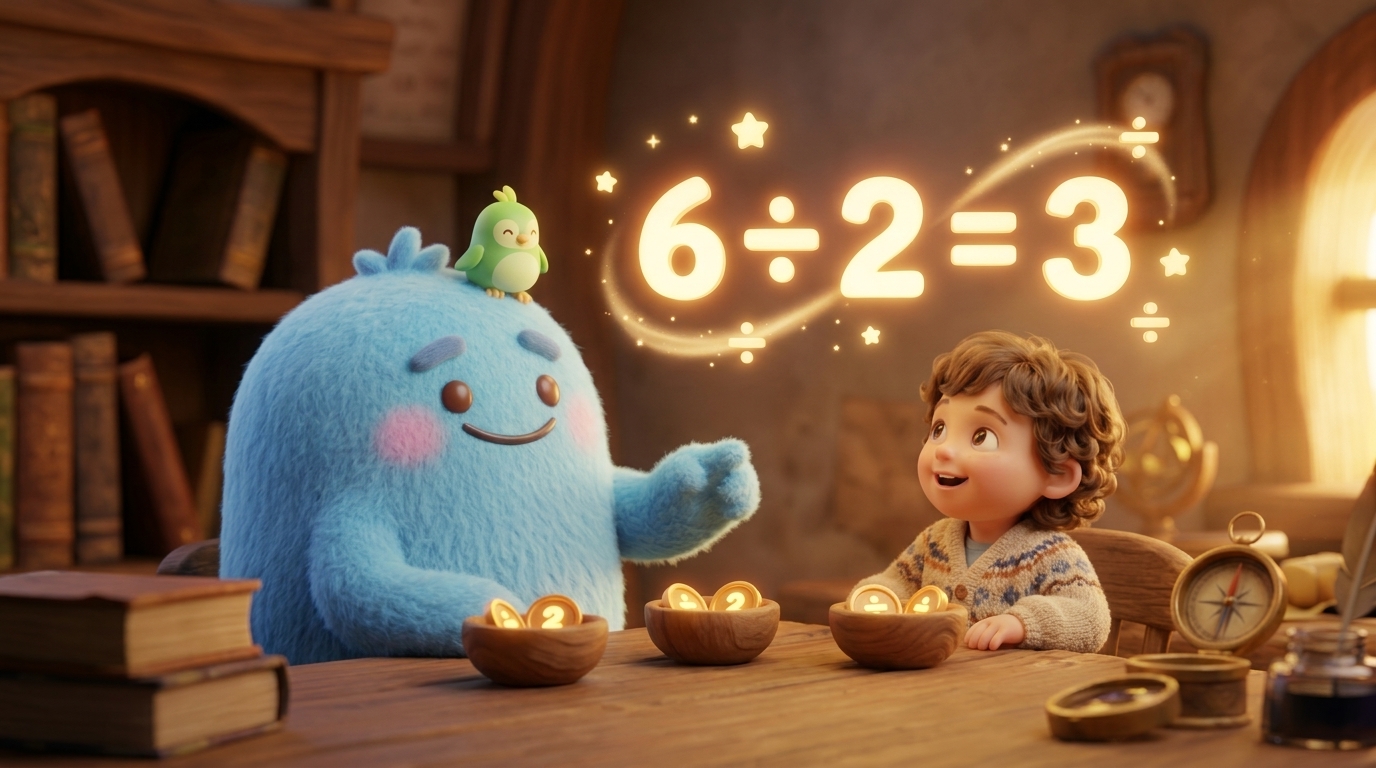
To explain division to a child, start by sharing objects equally. Twelve blocks shared between three boxes give four blocks in each: 12 ÷ 3 = 4. Let your child distribute and check the objects before introducing notation.
Division also asks how many groups can be made when the group size is known. Twelve blocks packed three per box make four boxes. The answer is still four, but it describes something different. Explore these two meanings separately.
Division for children: sharing equally
Set out three plates and twelve blocks. Give each plate one block per round until all are distributed. Compare the groups in pairs or rows, then count one plate: each person receives four.
If your child distributes several at once, that is fine. Check that every group has the same quantity and all the blocks were used. The method of handing them out need not be identical.
How many groups of three?
Keep twelve blocks but remove the plates. Ask how many boxes you need when each holds three. Make groups of three until there are four groups.
In the first story, three named the number of recipients. Here it names the number of blocks per box. Say the full answer: “Four blocks each” or “Four boxes.” Our introduction to multiplication explores group number and group size too.
Connect each number with the story
Write 12 ÷ 3 = 4 beside the arrangement. Point to the whole collection, the three plates and the four blocks per plate. For the packing story, point to three per box and four boxes instead.
Some resources use a colon rather than ÷. Start with the notation familiar from school, explaining alternatives when they appear. Draw the groups and return to objects whenever the picture is unclear.
Pizza and fruit: name the unit
Eight already-cut, equal pizza slices shared between four people give two slices each: 8 ÷ 4 = 2. The answer is not two whole pizzas.
Sharing one pizza into four equal parts gives a quarter each, which introduces fractions. You can leave that for a separate conversation. Similarly, six mandarins and six mandarin segments are different units: keep the question and answer consistent.
Check division with multiplication
Three groups of four blocks make twelve: 3 × 4 = 12. Sharing those twelve between three gives four per group: 12 ÷ 3 = 4.
Explore 12 ÷ 4 as well, clearly stating whether four means recipients or objects per group. For a smaller model, use six blocks in two groups of three. Revisit addition with objects if joining groups is still unfamiliar.
What if something remains?
Share seven indivisible blocks between three people. Each gets two, with one left over. Giving the last block to one person would make the groups unequal.
For now, naming the remainder is enough. A food item might be divided into parts, but a block is kept whole. The situation determines whether you discuss leftovers or fractions. Include examples without remainders while equal sharing is new.
What can you try today?
Use eight blocks and two containers. First share equally between the containers; then collect everything and make groups of two. Say what the answer counts each time.
Number Land includes sharing and grouping activities as additional practice. For real-life contexts, see maths in everyday life.
Parents’ questions
Must children know every multiplication fact first?
Not to share small collections. Familiar multiplication facts can later help check answers.
Does division always make a number smaller?
That is not a rule for all numbers. In these positive whole-number examples, dividing by more than one makes the number smaller; dividing by one leaves it unchanged.
What if the groups are unequal?
Compare them and move objects until they match. Ask which group needs another object instead of supplying the answer immediately.
A final thought
Clarify whether you want the number of groups or the amount in each. Objects, complete answers and multiplication checks connect the symbols with the situation.