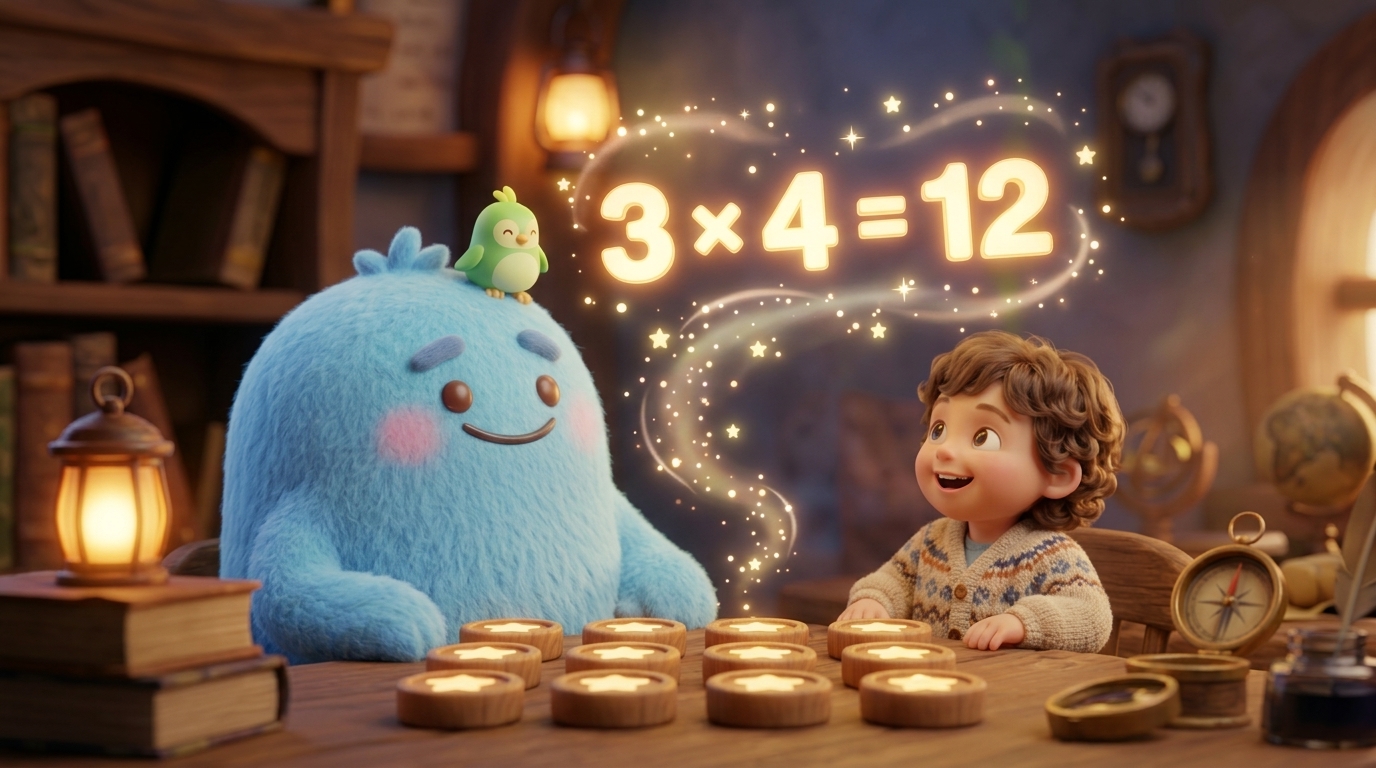
Times tables for children can begin with equal groups rather than a page of answers. Three mats with four blocks on each already give you a way to discuss “three groups of four.” Exploring that idea does not commit a child to memorizing an entire table by a particular age.
Watch what happens in a shared task: can your child make equal groups and understand the question “How many altogether?” These activities help you choose a starting point; they are not a school-readiness test.
Times tables for children: before the table
Offer three plates and twelve blocks. Ask for four blocks on each plate. Then ask separately: How many plates? How many blocks on one plate? How many blocks altogether?
If every answer is “four,” point to what you are counting each time. Try two plates with two blocks if necessary. Distinguishing the number of groups from the size of each group is the immediate task, not using large numbers.
When can you introduce multiplication?
Offer equal-group play when it fits your child's interests and is understandable. A preschooler can arrange pairs of shoes for dolls without learning multiplication notation. A schoolchild can connect the same model with classroom work.
Avoid setting a birthday deadline. Ask the teacher which notation and tasks are being introduced. If counting the collection is demanding, use smaller groups or revisit number sense activities.
Three groups of four: 3 × 4
Arrange four blocks on each of three mats. Count all twelve, then point to the groups while saying four, eight, twelve. Write 4 + 4 + 4 = 12, then 3 × 4 = 12: three groups of four in this story.
Show which number refers to the groups and which to the blocks per group. Draw the arrangement if useful. Add one more group of four: the known twelve plus four becomes sixteen. Discuss what changed rather than treating it as an unrelated answer.
Rows and columns
Arrange twelve blocks in three rows of four. You can also see four columns of three: 3 × 4 = 4 × 3 = 12. Outline rows and columns on separate drawings if the two groupings are difficult to see.
The total stays the same, but three boxes with four pencils are not the same packaging as four boxes with three pencils. Equal results do not make every detail of the stories identical.
Practise connected examples
Choose a small family of examples, such as pairs of shoes for one, two and three dolls. Write answers beside the pictures. There is no need to follow a particular table order if another starting point is clearer.
Use known results to rebuild forgotten ones. Three groups of four make twelve; a fourth adds four. Memorizing answers can be part of practice, alongside asking how to show or recover them. Our visual times-table guide explores arrays and skip counting further.
Keep the first sessions simple
Do not introduce the full table, a timer and lots of writing at once. If your child counts every object, show grouping as another option rather than banning their method.
Separate a grouping error from a counting error. Four plates instead of three calls for rereading the story; a correct model counted as eleven calls for checking the objects.
What can you try today?
Arrange three mats and invite your child to put four blocks on each. Ask each question separately. Draw and write one equation only if useful.
Next time, change the objects or number of groups. Number Land includes multiplication activities with equal groups and visual arrangements as additional practice, without promising instant recall.
Parents’ questions
Can multiplication start before school?
Equal-group play can be offered when a child is interested. It need not become a full times-table course or an age-based target.
Must the table be memorized?
Recalling results can be useful in later tasks. Connect it with understanding and rebuilding an answer. Discuss school expectations with the teacher.
When can division appear?
Reverse a familiar activity: share twelve blocks between three groups. Our division guide explains the first examples.
A final thought
Start with groups and the meaning of each number. Understanding and remembering can work together, with the amount of practice adapted to your child.