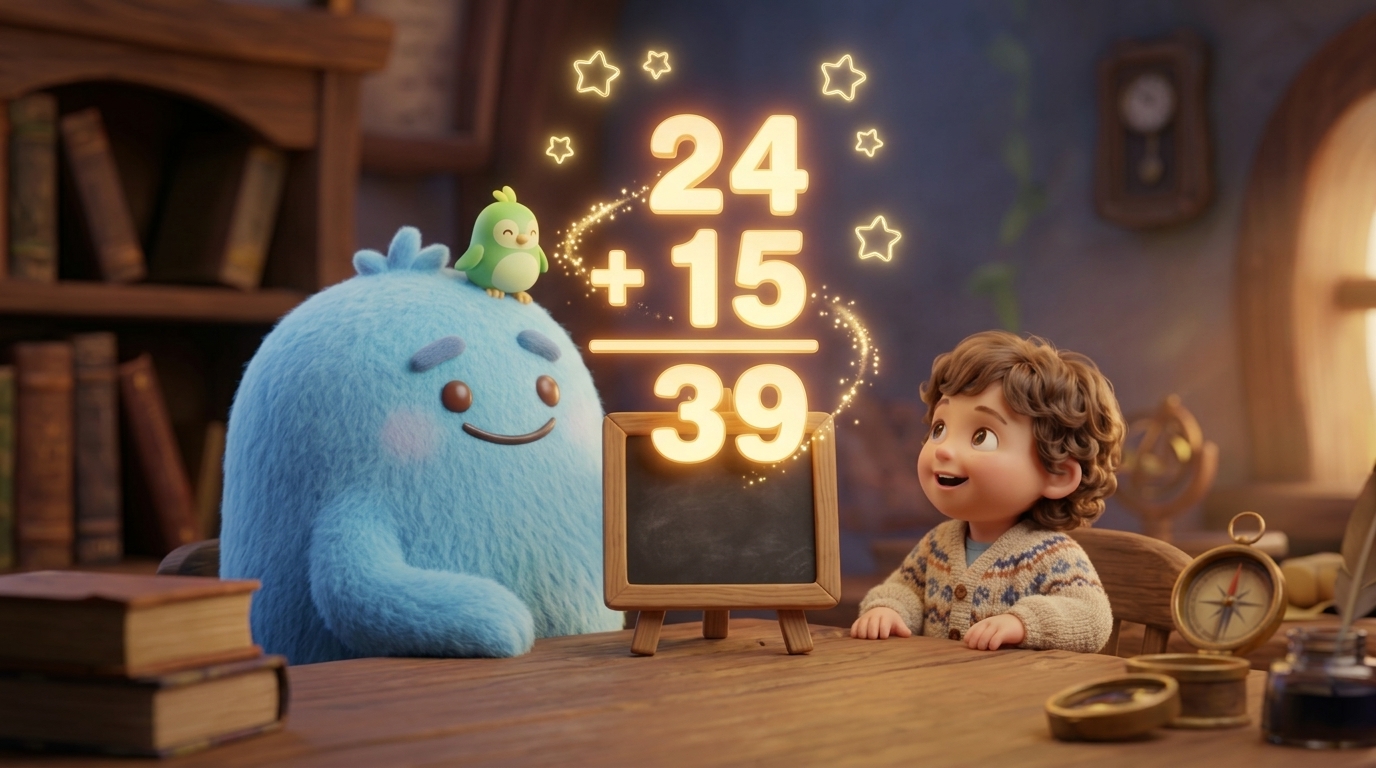
Begin column addition and subtraction with ones and tens, before arranging digits under a line. Ask your child to show 23 as two groups of ten and three single objects. If that connection is unclear, explore it separately before introducing a whole calculation.
“Ready” here means finding a useful starting task, not meeting an age standard. This guide focuses on place value and first written examples. Our earlier guide to visual column-math models explores further explanations and game examples.
Column maths: what is useful to explore first?
Bundle ten sticks or join ten blocks. Make and undo the bundle. Two bundles and three singles represent 23: the two stands for twenty, the three for three ones. Change the written number to 32 and adjust the model.
These are observations, not entrance requirements. If a step is unclear, it gives you something to work on. Ask the teacher how regrouping is recorded in class to keep notation familiar.
Align ones with ones and tens with tens
Draw columns labelled T and O. For 23 + 14, place 2 and 1 in the tens column, 3 and 4 in the ones column. Put plus on the left and a line below.
For 23 + 5, the five belongs under the three, not the two. Read the numbers before calculating: a misplaced five could accidentally turn the task into 23 + 50. Squared paper can help keep positions clear.
Column addition without regrouping: 23 + 14
Build both numbers. Three ones and four ones make seven; write 7 in the ones column. Two tens and one ten make three tens; write 3 in the tens column. The answer is 37.
Read it as three tens and seven ones. Check using 20 + 10 = 30 and 3 + 4 = 7. If plus itself is unfamiliar, revisit first addition activities.
Column addition with regrouping: 27 + 15
Seven ones plus five ones make twelve. Bundle ten of them, leaving two singles. Twelve ones equal one ten and two ones. Write 2 below in the ones column and record the new ten above the tens column.
Now add two original tens, one ten from fifteen and the newly formed ten: four tens. The answer is 42. If the carried digit is forgotten, ask where the new bundle appears on paper rather than simply saying “Write one.”
Column subtraction without exchanging: 46 − 23
Build four tens and six ones. Remove three ones, leaving three. Remove two tens, leaving two. The answer is 23.
Check by returning the removed objects or calculating 23 + 23 = 46. Both parts should rebuild the starting quantity.
Column subtraction with exchanging: 42 − 15
Four tens and two ones do not show five loose ones to remove. Unbundle one ten. You now have three tens and twelve ones, still worth 42.
Record the exchange using the school's notation. Twelve ones minus five leave seven; three tens minus one leave two. The answer is 27.
Do not reverse 2 − 5 into 5 − 2 within the column. The starting number must be represented differently. Our subtraction guide explains taking away and comparing before written methods.
What can you try today?
Choose one calculation, or simply build 23. Use the model beside the two written columns. Ask what each digit represents, then swap roles so your child chooses a number for you to build.
Number Land includes written addition and subtraction activities with visual models. They provide another way to practise, alongside discussing the notation and choosing suitable tasks.
Parents’ questions
Are written calculations suitable before school?
Age alone does not determine which explanation is understandable. Play with groups of ten without introducing a whole algorithm, and discuss school expectations with the teacher.
Does the small carried one mean one object?
It means one unit of its column. In this addition example it represents one ten, or ten ones.
What if a child knows the rule but cannot explain it?
Recreate a small example with objects and ask about one step, such as making a new ten, rather than demanding the entire explanation.
A final thought
Column alignment, making tens and exchanging tens have visible meanings. Let the clarity of each step guide the next example rather than the number of completed calculations.