Subtraction for children can mean taking something away, comparing two quantities or finding a missing part. Start with a situation your child can act out: five apple pieces are on a plate, two move elsewhere and three remain. Then write 5 − 2 = 3.
Choose one meaning at a time. This guide explores what subtraction represents, before written algorithms or fast mental calculation.
Subtraction for children: taking away
Set out six blocks and hide two in a box. Ask how many remain on the table. The equation 6 − 2 = 4 records the starting quantity, the removed part and the remainder.
If your child counts the hidden blocks too, clarify which group the question concerns. You still own six blocks, but four are on the table. A misunderstanding of the story need not be an arithmetic mistake.
Try the same relationship with cars leaving a parking space or books moving from a shelf. Draw six circles and cross out two, leaving them visible enough to show the original quantity.
Comparing groups: how many more?
Place five red blocks above three blue blocks, matching them in pairs. Two red blocks have no partner. There are two more red blocks, or two fewer blue blocks: 5 − 3 = 2.
Nothing was removed here. You compared quantities. Use similarly sized objects initially so that row length does not confuse the question about the number of pieces. Our number sense guide offers related comparisons.
Finding what is missing
There are three cups for five people. How many more cups are needed? Add cups until there are five: two were missing. Both 3 + 2 = 5 and 5 − 3 = 2 describe the relationship.
For 9 − 7, you can ask how far seven is from nine. Compare this with taking seven objects away from nine. Neither method must replace the other. Explore the connection with first addition activities.
Counting back and using a number line
For 5 − 2, start at five. The first step reaches four; the second reaches three. The starting point is not the first step. A moving counter can make that distinction visible.
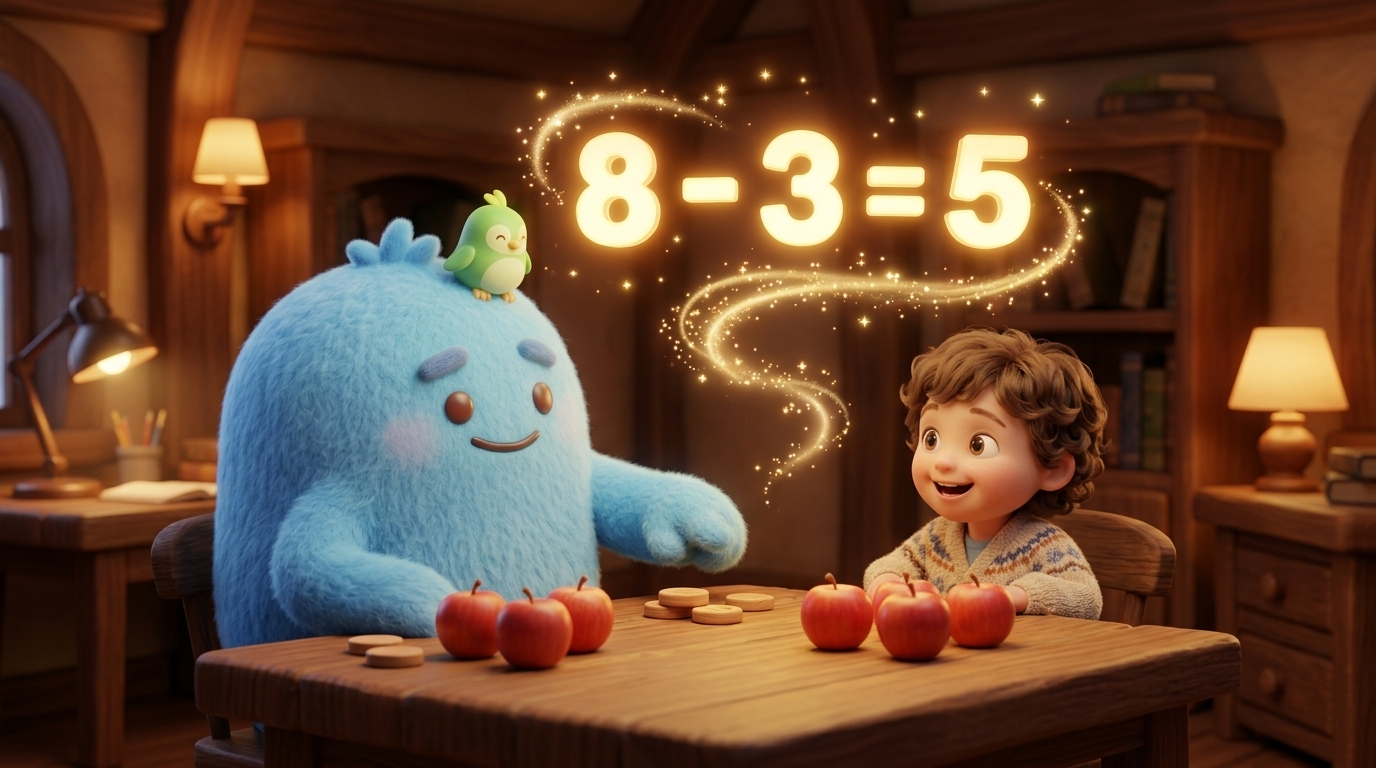
Draw equally spaced numbers from zero to ten, increasing to the right. For 8 − 3, start at eight and jump left to seven, six and five. Check the result with eight blocks, removing three. Explain how the jumps relate to the removed objects.
Larger jumps can come later. These first examples stay with nonnegative whole numbers and results of zero or more.
Three everyday activities
A shelf with fewer books
Move two of seven books to the sofa. Guess how many remain, then check. Swap roles so your child chooses a similar story.
Empty parking spaces
Draw six spaces and park four cars. Count the two empty spaces or fill them with more cars. Add 6 − 4 = 2 beside the completed model.
Towers to compare
Build towers of six and four identical blocks on the same surface. How many must be added to the shorter tower? Name the difference after showing it.
What can you try today?
Choose taking away, comparing or finding a missing part. Ask what you know and what you want to find. Let your child show the answer before writing it.
Simplify the story or use fewer objects if needed. Our guide to responding to mistakes suggests practical prompts.
Parents’ questions
Must subtraction always use counting backwards?
No. Removing objects, comparing groups and finding the missing part are other ways to represent it.
What if my child swaps the numbers?
Act out the story. Five apples minus two differs from two minus five. Begin with examples that do not require negative numbers.
Can an app provide practice?
Number Land includes subtraction activities with disappearing objects and number-line movements. Use them alongside objects and drawings.
A final thought
Clarify what is being removed, compared or completed before asking for an answer. A carefully discussed example can reveal which step needs more explanation.